

















2026.03.02
FXON Market Analysis (February 23 to March 1)

2026.03.02
This article was :
published
updated
In the foreign exchange market for the week that ended on March 1st, the yen sell-off accelerated due to media reports that Japanese Prime Minister Sanae Takaichi showed reluctance toward an additional rate hike. As a result, the USDJPY rose to the 156.8 yen range. However, the yen was later bought back, and the pair concluded its weekly trading session without a clear future direction. The EURUSD and GBPUSD also lacked direction, remaining flat on a weekly basis.
February 23 (Mon)
The Supreme Court overturned the Trump Tariff at the end of the previous week. Soon afterward, President Donald Trump refuted the decision and increased the tariff to 15%. Consequently, the USDJPY started its weekly trading session by falling to 153.99 yen as traders sold off the dollar. Later, the pair rebounded to the 155.0 yen range.
The EURUSD jumped to the 1.183 range but later fell back to the 1.177 range. The GBPUSD followed suit, falling to around the 1.35 level after reaching the 1.353 range.
February 24 (Tue)
At the meeting with Bank of Japan (BOJ) Governor Kazuo Ueda, Prime Minister Takaichi showed reluctance toward an additional rate hike. It reduced market speculation of an early rate hike by the central bank and triggered a sell-off of the yen. Consequently, the USDJPY surged to 156.28 yen intraday.
The EURUSD straddled the 1.177 level. The GBPUSD pair rose to the 1.353 range but then dropped back down, ultimately remaining flat.
February 25 (Wed)
The yen weakened further against the dollar after the Japanese government submitted a proposal for BOJ board member nominees. During the New York trading hours, the USDJPY extended its uptick to the 156.8 yen range. However, the pair fell back before reaching the 157 yen level.
The EURUSD reached the 1.18 range after significant fluctuation. Meanwhile, the GBPUSD climbed to the upper 1.35 range.
February 26 (Thu)
BOJ Governor Ueda did not rule out the possibility of an early rate hike, while Takaichi said the BOJ should be responsible for deciding how to adjust the rate. After moving softly, the USDJPY lost direction for the remainder of the day, hovering around the 156.0 yen level.
Meanwhile, European currencies weakened against the dollar during and after the London trading hours. The EURUSD fell to the 1.177 range, and the GBPUSD dropped below the 1.345 level.
February 27 (Fri)
The dollar weakened against the yen, backed by the intensifying contentions between the Trump administration and U.S. private companies, Trump's approval rating slump, and the counteraction to an early-week dollar surge triggered by the yen sell-off. Consequently, the USDJPY fell to the 155.5 yen range. However, the pair rebounded to the 156.1 yen range and concluded the weekly trading session by remaining flat in this range.
Meanwhile, the EURUSD edged up to the 1.182 range, and the GBPUSD halted its downtrend and rebounded to the 1.349 range.
The following currency pair charts are analyzed using an overlay of the ±1σ and ±2σ standard deviation Bollinger Bands, with a 20-period moving average.
As speculation about a March rate hike by the BOJ diminishes, traders are expected to continue to sell the yen. However, Takaichi's intention to curb a weak yen and intensifying tensions in the Middle East are leading to a contraction of the yen sell-off. The market remains wary that the government may conduct market intervention if the USDJPY surpasses the 157 yen level. Therefore, the pair's uptrend may pause.
Next is an analysis of the USDJPY daily chart.
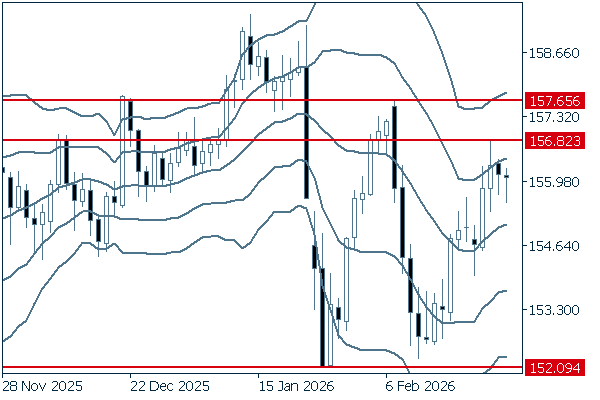
On the daily chart, the pair extended its rally while overcoming a few dips. However, the rally stopped after the pair touched 156.82 yen. It is difficult to determine whether the pair has just reached the peak of the current rally or will extend it again after the current dip. For now, it would be safe to say that the uptrend will likely continue, provided that the pair breaks above 156.82 yen.
We continue with an analysis of the USDJPY weekly chart.
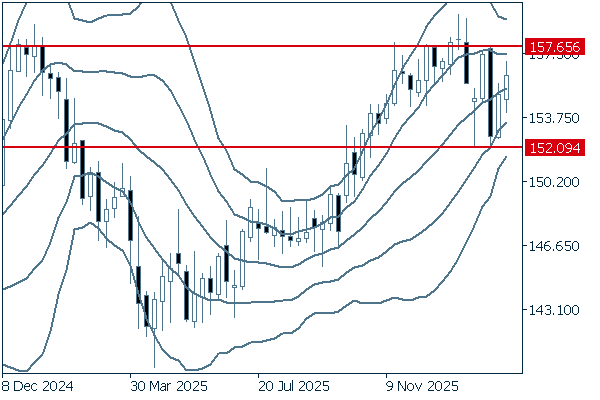
After nosediving from 157.65 yen to the 152 yen range, the pair has risen for two consecutive weeks and is close to erasing the nosedive. Since the middle line is trending upward, it is important to watch whether the pair can exceed the pre-plummet level.
Traders will prefer the euro if the eurozone's February HICP and January retail sales figures indicate strength in the region's economy. However, an increasing likelihood of U.S. military action against Iran may cap the euro's uptrend.
Next is an analysis of the EURUSD daily chart.
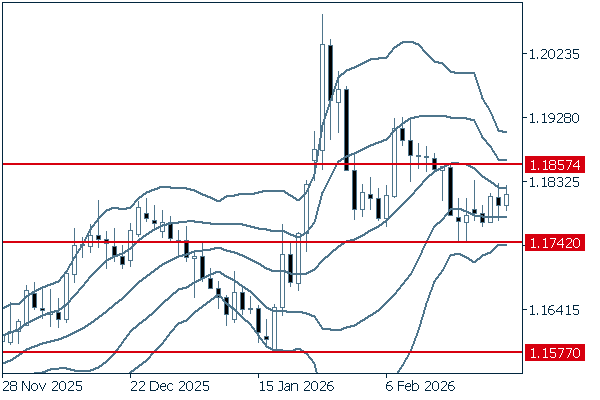
The pair has remained almost flat since falling to 1.1742, making it difficult to forecast its future direction. It would be better to wait and see whether it breaks above the 1.1857 level or falls below the 1.1742 level, and then follow the clarified trend.
We continue with an analysis of the EURUSD weekly chart.
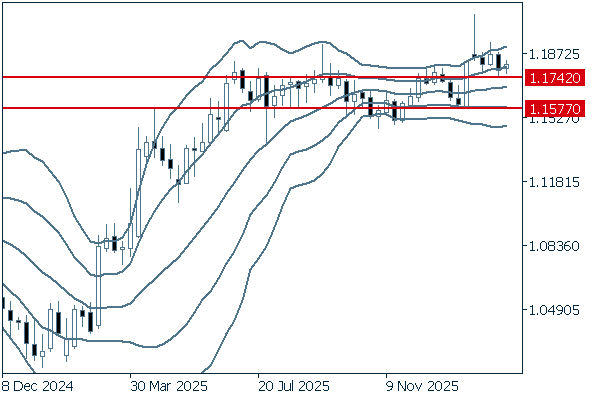
Although the pair rebounded last week, an increase in selling pressure is pinning it at +1σ. If the pair dips below the 1.1742 level, it will likely continue falling to as low as 1.1577.
The fragile situation in Iran and the surrounding Middle Eastern countries may put increasing selling pressure on the dollar, and in turn, the pound may be favored. The dollar's performance will dominate the market this week.
Next is an analysis of the GBPUSD daily chart.
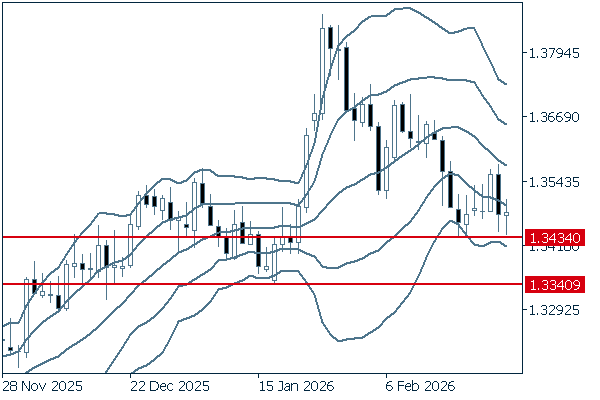
Selling pressure on the pound is dominant as the middle line is trending downward. The current support line seems to lie around the 1.3434 level. If the pair falls below it, the downtrend will likely intensify.
We continue with an analysis of the GBPUSD weekly chart.
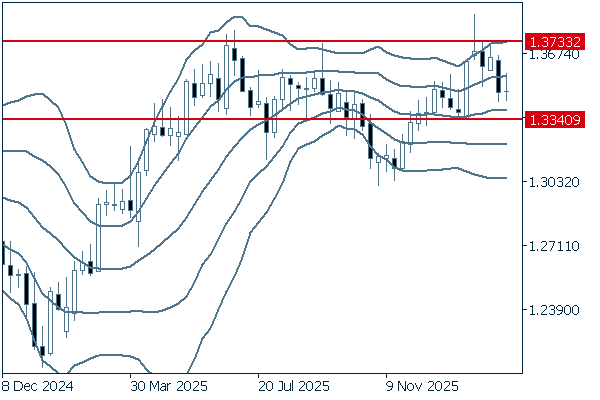
As was the case a couple of weeks ago, selling pressure is increasing. On the weekly chart, the support line seems to lie around the 1.334 level. If the pair falls below it, it would be a sign that the pair has entered a downtrend.
Don't miss trade opportunities with a 99.9% execution rate.
Was this article helpful?
 No
No
 Yes
Yes
0 out of 0 people found this article helpful.
Thank you for your feedback.


