

















2026.01.19
FXON Market Analysis (January 12 to January 18)

2026.01.19
This article was :
published
updated
The USDJPY experienced wild fluctuations. The yen continued to be sold off due to reports at the end of the previous week that Prime Minister Sanae Takaichi would dissolve the Lower House. Consequently, the pair initially rose to 159.45 yen. However, it then fell below the 158 yen level due to warnings against the weak yen. The EURUSD sagged throughout the week. The GBPUSD fell to the 1.336 range after midweek.
January 12 (Mon)
The market remained sensitive to the previous week's media reports that Takaichi would dissolve the Lower House. Traders took a risk-on stance and sold the yen. After hovering around the 158.2 yen level, the USDJPY rose to form a higher low.
Meanwhile, the EURUSD rebounded to the 1.169 range, and the GBPUSD climbed to the 1.348 range.
January 13 (Tue)
Japanese Financial Minister Satsuki Katayama warned against the weak yen. Nevertheless, the yen continued to be sold off. After the release of the U.S. Consumer Price Index (CPI) for December, the USDJPY dropped to around 158.60 yen. However, the pair then rebounded to a daily high of 159.19 yen.
Meanwhile, the EURUSD fell back to the 1.163 range. The GBPUSD rose to the 1.349 range, but then fell back to the 1.342 range to conclude the daily trading session.
January 14 (Wed)
The yen continued to weaken against the dollar. The USDJPY extended its uptick to 159.45 yen. However, the market highlighted caution about the Japanese government's intervention after both Financial Minister Katayama and Atsushi Mimura, Vice Minister of Finance for International Affairs, warned against the weak yen. As a result, the pair fell to 158.10 yen.
Meanwhile, the EURUSD hovered around the mid-1.16 range, and the GBPUSD rebounded slightly to the 1.346 range.
January 15 (Thu)
The USDJPY rebounded as speculation about Japan's possible aggressive fiscal policy following the dissolution of the Lower House triggered a sell-off of the yen. However, warnings against a weak yen and comments from an official at the Bank of Japan (BOJ) pushed the pair down after it reached its daily high of 158.87 yen.
The EURUSD dropped below the 1.17 level intraday. The GBPUSD declined to the 1.336 range.
January 16 (Fri)
Katayama issued another warning about the weak yen. As the dollar faced strong selling pressure, the USDJPY fell to a daily low of 157.82 yen, struggling to rebound.
Meanwhile, the EURUSD rose to 1.1627 before falling to 1.1584. The GBPUSD climbed back to 1.341, only to fall to 1.336. The pair concluded the weekly trading session in the upper 1.33 range.
Closure: U.S. (holiday)
The following currency pair charts are analyzed using an overlay of the ±1σ and ±2σ standard deviation Bollinger Bands, with a 20-period moving average.
The market expects that, if the ruling party wins the upcoming Lower House election, the Japanese government will become more aggressive with its fiscal policy. However, the market also believes that this policy could worsen the government's fiscal condition. Accordingly, the dollar will likely continue to strengthen against the yen.
On the other hand, the Japanese government is becoming increasingly cautious about a weak yen. Thus, the pair's uptick may halt after breaking above the 159 yen level due to the market's caution regarding possible market intervention by the Japanese government.
Next is an analysis of the USDJPY daily chart.
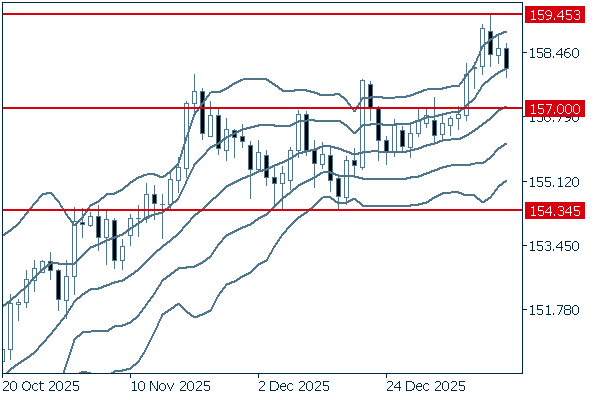
Selling pressure increased after the pair reached 159.45 yen. Nevertheless, the middle line maintains an upward trend. If the pair falls below 157 yen, a trend reversal may occur. However, unless this happens, it is safe to say that the uptrend will likely continue.
We continue with an analysis of the USDJPY weekly chart.
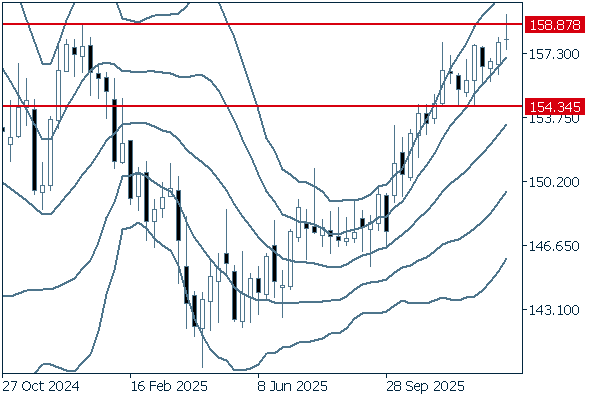
Last week's long upper wick indicates an increase in selling pressure. However, the strong trend is continuing overall. The pair may rebound even after a brief decline and extend its rally. Therefore, it is safe to say that the uptrend will likely continue.
Uncertainty in the Middle East is expected to ease. Also, U.S. President Donald Trump maintains his intention to own Greenland. Therefore, the dollar continues to strengthen against the euro. Meanwhile, if the improvement in the eurozone's business confidence is confirmed, the ECB will be expected to keep its interest rate unchanged for a while.
Next is an analysis of the EURUSD daily chart.
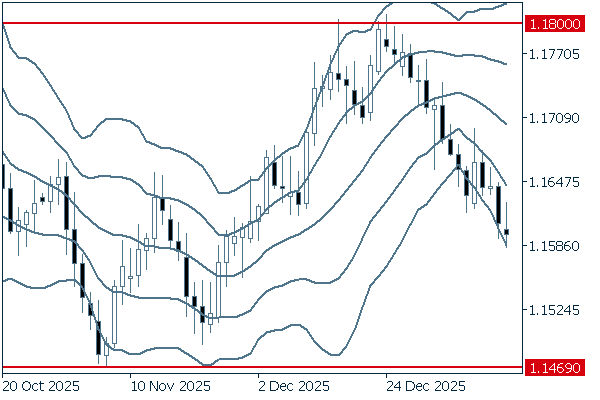
The pair is in the midst of a downtrend. On the daily chart, the middle line is trending down. If the pair falls below the 1.1469 level, it may enter a medium-term downtrend.
We continue with an analysis of the EURUSD weekly chart.
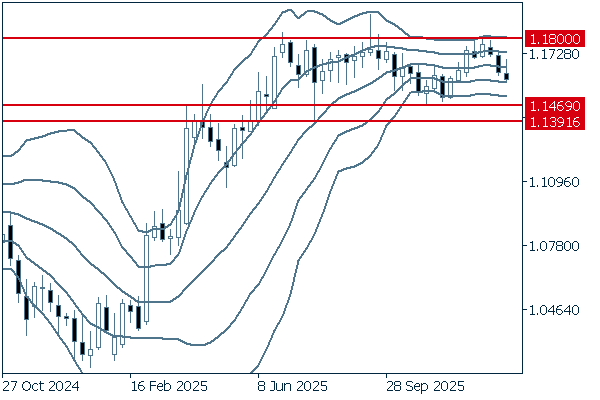
On the weekly chart, three consecutive negative candlesticks appear. Also, a long upper wick on the latest candlestick indicates massive selling pressure on the euro. It is important to watch whether the pair falls below the 1.1469 level in order to predict the future trend.
In the U.S., important economic indicators will be released on January 22nd and 23rd. As geopolitical risks tend to encourage traders to buy the dollar, its behavior will dominate the GBPUSD.
Next is an analysis of the GBPUSD daily chart.
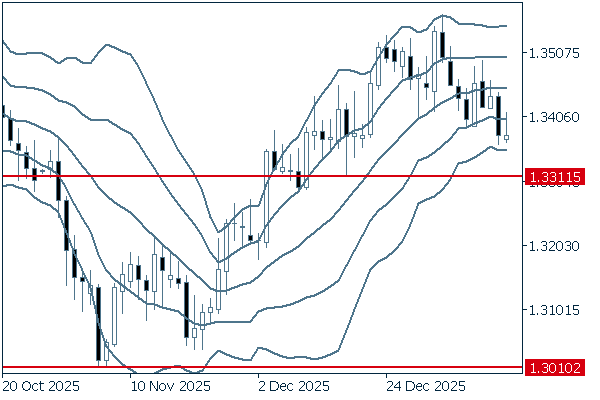
It appears that the downtrend came to an end. However, the pair continues to experience repeated sell-offs during rallies. If the pair falls below the 1.3311 level, the downtrend will likely intensify.
We continue with an analysis of the GBPUSD weekly chart.
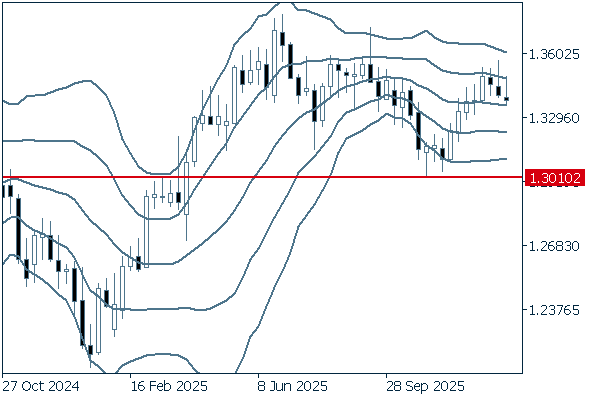
On the weekly chart, the pair is forming lower lows as each week's high reaches below the previous week's low. In other words, selling pressure is dominating the market. If the pair falls below the 1.3010 level, the current downtrend could intensify. Therefore, it is reasonable to assume that the downtrend will continue.
Don't miss trade opportunities with a 99.9% execution rate.
Was this article helpful?
 No
No
 Yes
Yes
1 out of 1 people found this article helpful.
Thank you for your feedback.


