

















2026.01.05
FXON Market Analysis (December 29, 2025 to January 4, 2026)

2026.01.05
This article was :
published
updated
In the foreign exchange market for the week that ended on January 4th, trading volume shrank over the New Year's holiday, with fewer traders participating. The yen weakened slightly against the dollar, pushing the USDJPY up from the upper 155 yen range to 157.0 yen. Meanwhile, both the EURUSD and GBPUSD showed weak movement as they struggled to climb.
December 29 (Mon)
The Summary of Opinions from the December Monetary Policy Meeting of the Bank of Japan (BOJ) revealed that some policymakers took a hawkish stance. Accordingly, traders preferred to buy the yen, and the USDJPY temporarily fell below the 156 yen level.
Meanwhile, the EURUSD showed no clear direction, hovering in the upper 1.17 range. The GBPUSD moved within the upper 1.34 range.
December 30 (Tue)
Initially, the yen strengthened against the dollar. After USDJPY fell to 155.74 yen, traders started buying back the dollar. Consequently, the pair rebounded to the 156.5 yen range. However, it moved within a limited range throughout the day. Even after the Federal Open Market Committee (FOMC) meeting in December, the market anticipates that the Federal Reserve Board (FRB) will keep the interest rate unchanged at the January meeting.
The EURUSD rebounded to 1.177 but then fell below the 1.175 level. The GBPUSD rose to 1.353 before plummeting to the 1.344 range.
December 31 (Wed)
Trading volume shrank worldwide on the eve of New Year's Day. The buyback of the dollar lifted the USDJPY to the 157 yen range during New York trading hours.
The EURUSD halted its decline at the 1.172 range. Meanwhile, the GBPUSD continued to fall to the 1.340 range. However, the pair later rebounded to the 1.348 range to conclude the yearly trading session.
January 1 (Thu)
Financial markets worldwide closed. Due to little trading activity, there were no major fluctuations in the foreign exchange market.
January 2 (Fri)
The Tokyo market was closed. The USDJPY remained steady but struggled to advance beyond the 157 yen level.
As the dollar strengthened against major currencies, the EURUSD dropped to the 1.171 range, and the GBPUSD hovered in the upper 1.34 range.
The following currency pair charts are analyzed using an overlay of the ±1σ and ±2σ standard deviation Bollinger Bands, with a 20-period moving average.
The U.S. employment figures, to be released on January 9th, are expected to be relatively solid given the effects of the U.S. government shutdown. If the figures indicate a robust employment market, speculation about an additional U.S. rate cut will decrease, and the dollar will strengthen against the yen.
Next is an analysis of the USDJPY daily chart.
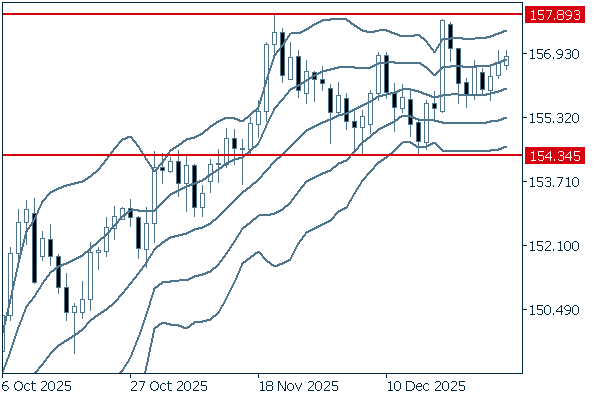
The pair has been fluctuating within a fixed range. It is important to watch whether it can break above the 157 yen level and advance further. As long as the pair stays above 154.34 yen, the current uptrend will likely continue.
We continue with an analysis of the USDJPY weekly chart.
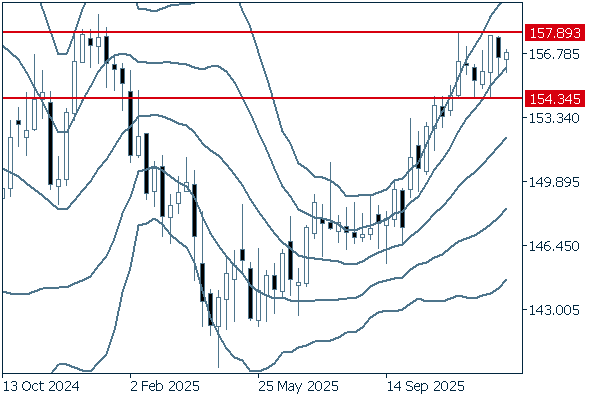
Although the middle line maintains an upward trend on the weekly chart, the pair has been fluctuating within a fixed range for a few weeks. If it can break above the 157.89 yen level and enter the 158 yen range, it may continue to climb.
It is expected that the eurozone economy in 2026 will hinge on how well its member countries can overcome policy uncertainties, fiscal restrictions, and the adverse effects of Trump tariffs on trade. For now, the euro is weakening against the dollar. U.S. employment figures, to be released on January 9th, might reverse the uptrend that has continued since November 2025.
Next is an analysis of the EURUSD daily chart.
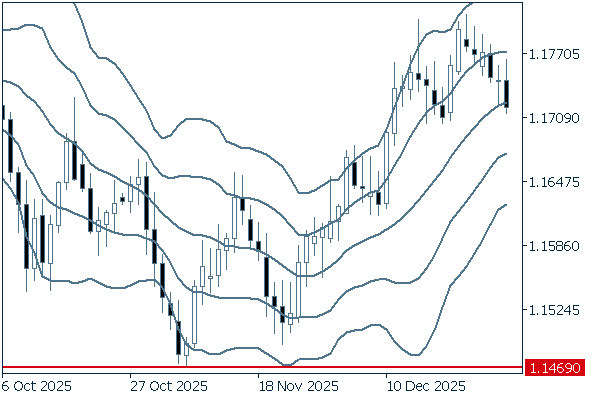
On the daily chart, since reaching +2σ, the pair has been facing an increase in selling pressure. It is now important to watch whether the current decline gives traders a chance to buy on dips that lead the pair to rebound. However, if the pair falls below the 1.170 level, the long-lasting uptrend may reverse.
We continue with an analysis of the EURUSD weekly chart.
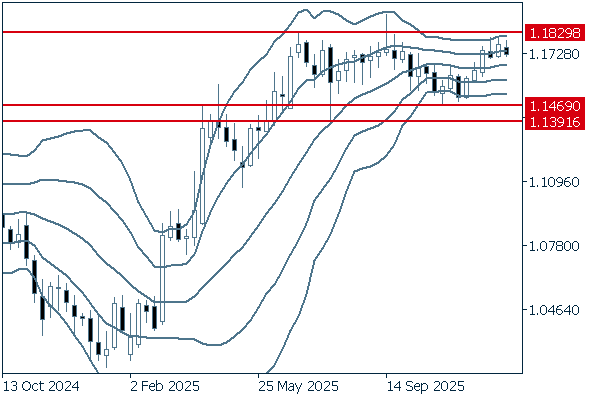
The pair has continued to move sideways as the bandwidth is narrowing. When it reaches the 1.180 level, selling pressure increases. Therefore, a resistance line can be drawn at this level. If the pair breaks above this line, the uptrend will likely strengthen after periods of stagnation.
The growth of the U.K. economy depends on consumer attitudes. If consumers become less cautious, demand for the pound will increase. Last week, the GBPUSD fell to around the 1.34 level. Therefore, it is crucial to determine now whether the uptrend will continue in the medium term.
Next is an analysis of the GBPUSD daily chart.
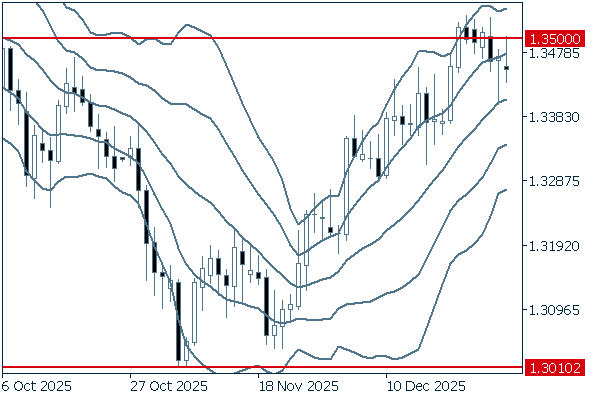
On the daily chart, the pair has a pattern of rebounding after a period of decline and extending its rally. Last week, the pair rebounded after falling to the middle line. To determine the medium-term trend, it is important to watch whether the pair can maintain its rally and break clearly above the 1.35 level.
We continue with an analysis of the GBPUSD weekly chart.
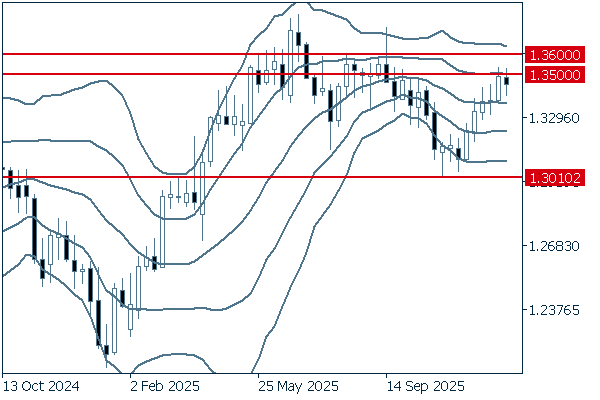
On the weekly chart, a negative candlestick appears following five consecutive positive candlesticks. Since the latest candlestick has both an upper and lower wick, it is difficult to determine whether the pair will move up or down. If the pair breaks above the 1.35 level again, it is safe to say that the uptrend will likely continue.
Don't miss trade opportunities with a 99.9% execution rate.
Was this article helpful?
 No
No
 Yes
Yes
0 out of 0 people found this article helpful.
Thank you for your feedback.


