

















2026.03.23 NEW
FXON Market Analysis (March 16 to March 22)

2026.03.23 NEW
This article was :
published
updated
During the week that ended on March 22nd, the foreign exchange market faced dual risks: growing tension in the Middle East and monetary policy announcements from major central banks. The market was especially sensitive to significant oil price fluctuations. The USDJPY rose to just below 160 yen but later plummeted to the 157 yen range. Meanwhile, the EURUSD climbed from the 1.14 range to the 1.16 range, and the GBPUSD recovered to the 1.34 range.
March 16 (Mon)
The USDJPY started the weekly trading session by reaching 159.75 yen following news that U.S. forces had attacked Kharg Island and a top Iranian official had been killed. Later, the pair fell to 158.85 yen as the risk-on atmosphere eased and crude oil prices dropped due to profit-taking.
Meanwhile, the EURUSD and GBPUSD moved steadily, reaching the 1.152 and 1.33 ranges, respectively.
March 17 (Tue)
Amid the ongoing unpredictability in the Middle East, the USDJPY moved up and down in an unstable manner, rebounding to just below 159.5 yen before falling to 158.72 yen.
The EURUSD initially fell but later rose to the 1.154 range. The GBPUSD edged up to the mid-1.33 range.
March 18 (Wed)
Volatility in crude oil prices temporarily eased. Consequently, the USDJPY fell to the 158.5 yen range. However, military attacks by Israel and Iran sparked a dollar buyback. Also, at the press conference following the Federal Open Market Committee (FOMC) meeting, Federal Reserve Board (FRB) Chair Jerome Powell expressed reluctance to cut interest rates. This stance further bolstered the dollar, pushing the USDJPY to a daily high of 159.89 yen.
Meanwhile, the EURUSD fell to the 1.144 range as investors sold the euro on a rally. The GBPUSD also dropped to the 1.325 range.
March 19 (Thu)
Bank of Japan (BOJ) Governor Kazuo Ueda's hawkish stance fueled speculation that the central bank would raise interest rates in April. Additionally, Israel and Iran reciprocally attacked Middle Eastern gas fields. It led to soaring energy prices and stock market plunges in Europe. These factors prompted traders to take a risk-off stance and prefer the yen. Consequently, the USDJPY plummeted from the 159 yen range to 157.5 yen.
As the dollar weakened, the EURUSD rebounded toward the 1.161 range and the GBPUSD rose to the 1.346 range intraday.
March 20 (Fri)
While the Tokyo market was closed due to a national holiday, media reports that the Trump administration would consider occupying or blockading Kharg Island prompted traders to resume a cautious mindset and buy the dollar. The USDJPY jumped from the 157 yen range to the 159.3 yen range.
Meanwhile, the EURUSD fell back to the 1.15 range. The GBPUSD plummeted below the 1.33 level but later returned to the 1.334 range to conclude the weekly trading session.
The following currency pair charts are analyzed using an overlay of the ±1σ and ±2σ standard deviation Bollinger Bands, with a 20-period moving average.
It has been three weeks since the U.S. and Israel launched a military attack on Iran. However, uncertainty about the Middle East situation lingers, and the crude oil price remains high. Meanwhile, the market seems to be lowering speculation that the U.S. will ease its monetary policy. Additionally, traders prefer a risk-on stance to buy the dollar.
On the other hand, the market is still so cautious about foreign exchange intervention that the momentum of dollar buying could weaken once the pair reaches around 160 yen.
Next is an analysis of the USDJPY daily chart.
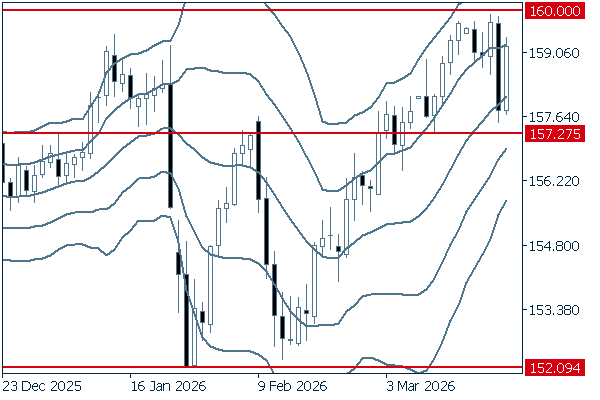
Last Thursday, the pair plummeted from just below 160 yen to the 157 yen range and crossed below the middle line. The following day, the pair rebounded to +1σ. While the current target is 160 yen, the pair could drop significantly once it reaches there.
We continue with an analysis of the USDJPY weekly chart.
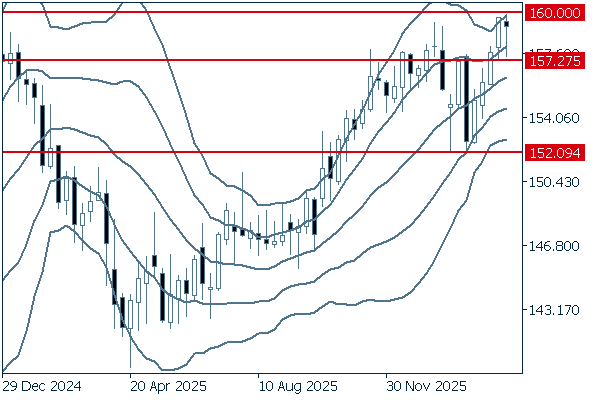
A long lower wick on the latest negative candlestick indicates that the pair, which had extended its rally after the plunge six weeks ago, temporarily reached the pre-plunge level. However, it then rebounded to conclude last week's trading session with a slight decline from two weeks prior. As long as the pair stays above the 157.27 yen level, it is safe to say that the uptrend will likely continue.
Although speculation emerged that the European Central Bank (ECB) would raise interest rates by the end of 2026, traders are more cautious about the negative effect that high crude oil prices will have on the eurozone economy. Therefore, the momentum of buying the euro will be limited. Meanwhile, the dollar will continue to be favored as a safe-haven currency. Overall, the EURUSD will steadily move throughout the week.
Next is an analysis of the EURUSD daily chart.
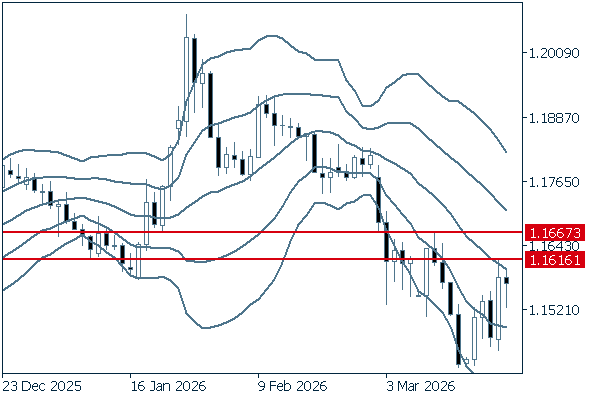
Last week, the pair rose to touch the middle line but then fell back again to close Friday's trading session. It is important to note that some traders may take advantage of this rally phase to sell the euro. However, if the pair breaks above the 1.1667 level, the uptick may continue in the short term.
We continue with an analysis of the EURUSD weekly chart.
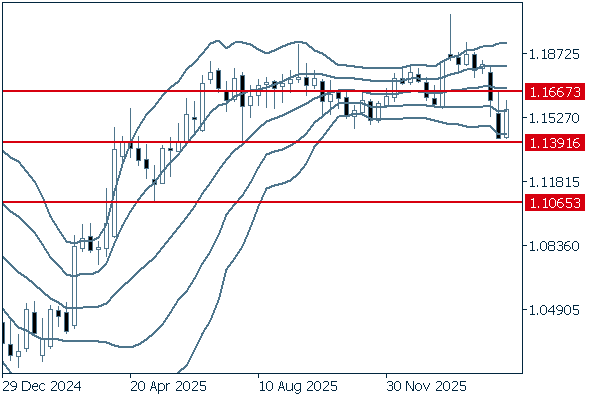
On the weekly chart, the pair rebounded from the 1.1391 level to -1σ. There is a possibility that the pair will extend this rally and return to the fixed range. However, if it falls below 1.1391, the downtrend will likely continue.
It is expected that the persistently high oil prices triggered by the worsening situation in the Middle East will have a negative impact on the U.K. economy. Additionally, in this emergency situation, the dollar will be preferred as a safe-haven currency. Therefore, the GBPUSD will struggle to advance this week.
Next is an analysis of the GBPUSD daily chart.
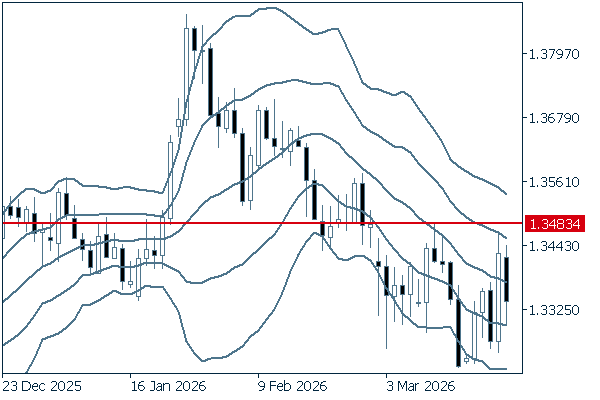
While the middle line is trending down, the pair has been staying flat since falling to the level of the current low. However, if it closes above the 1.3483 level on a daily basis, the uptrend will likely continue in the short term.
We continue with an analysis of the GBPUSD weekly chart.
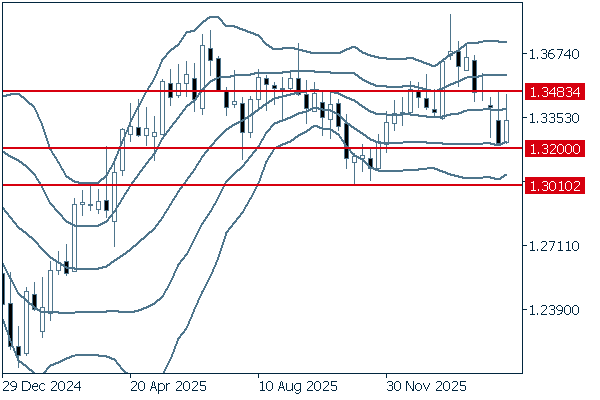
On the weekly chart, the pair moved up last week. However, a long upper wick on the latest positive candlestick signals an increase in selling pressure. It is currently important to watch whether the pair crosses below the 1.32 level at the close of the weekly trading session.
[Important] Service Suspension & Migration Schedule
Was this article helpful?
 No
No
 Yes
Yes
0 out of 0 people found this article helpful.
Thank you for your feedback.


