

















2026.02.16
FXON Market Analysis (February 9 to February 15)

2026.02.16
This article was :
published
updated
In the foreign exchange market for the week that ended on February 15th, the yen strengthened against the dollar. A landslide win by the Liberal Democratic Party (LDP) in the Lower House election boosted expectations toward stabilizing Japanese politics. The USDJPY fell throughout the week to enter the 152 yen range. Meanwhile, widespread uncertainty over the U.K.'s Starmer Cabinet sparked a sell-off of the pound.
February 9 (Mon)
Following the LDP's landslide win in the Lower House election, the USDJPY started the weekly trading session by extending its rally to the 157.6 yen range. However, expectations of political stability in Japan spurred yen buying, pushing the pair down to the 155.5 yen range.
Meanwhile, the EURUSD jumped to the 1.19 range, and the GBPUSD climbed to the 1.37 range intraday.
February 10 (Tue)
The yen continued to be preferred over the dollar. Additionally, U.S. Secretary of Commerce Howard Lutnick seemingly allowed a weak dollar. Furthermore, some media outlets reported that the Chinese government requested its banks reduce their holdings of U.S. Treasuries. As a result, the USDJPY dropped as low as 154.05 yen.
The EURUSD climbed to the 1.192 range. Conversely, political uncertainty in the U.K. caused the GBPUSD to dip to the lower 1.36 range.
February 11 (Wed)
While the Tokyo market was closed due to a national holiday, the USDJPY extended its decline earlier in the day. Later, U.S. employment figures for January propelled the pair to the 154.5 yen range. However, it then plummeted to the 152.5 yen range.
The EURUSD and GBPUSD were also sensitive to these significant fluctuations. The former plummeted to the 1.183 range, while the latter tumbled from the 1.371 range to the 1.360 range.
February 12 (Thu)
After dropping to a daily low of 152.26 yen earlier in the day, the USDJPY rebounded to temporarily enter the 153.7 yen range. However, throughout the day, the pair mainly straddled the 153.0 yen level.
The EURUSD was also directionless as the pair hovered in the upper 1.18 range. The GBPUSD rebounded to the 1.367 range but soon afterward fell back down to the lower 1.36 range.
February 13 (Fri)
The USDJPY moved steadily during Tokyo and London trading hours, reaching a daily high of 153.66 yen. However, the weaker-than-expected U.S. Consumer Price Index (CPI) for January triggered a sell-off of the dollar, pushing the pair down to the 152.6 yen range.
Meanwhile, after wild fluctuations, the EURUSD closed the daily trading session unchanged from the previous day, remaining in the upper 1.18 range. The GBPUSD halted its downtrend and rallied to the 1.365 range to conclude the weekly trading session.
The following currency pair charts are analyzed using an overlay of the ±1σ and ±2σ standard deviation Bollinger Bands, with a 20-period moving average.
Japan's Takaichi Cabinet is expected to maintain its expansionist fiscal policy following its landslide electoral victory. Accordingly, the yen may face persistent selling pressure due to concerns about fiscal deterioration. Meanwhile, the USDJPY fell and entered 152 yen last week and is approaching 152.1 yen, a daily low on January 27th. If the pair drops below this crucial level, there is a possibility that it will fall to as low as 150 yen.
Next is an analysis of the USDJPY daily chart.
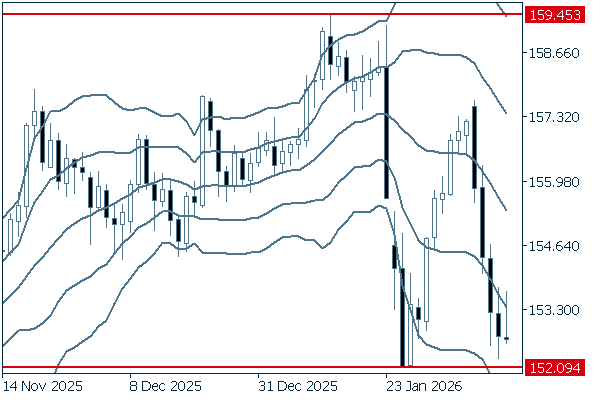
Five consecutive negative candlesticks appear on the daily chart. The middle line is also trending downward. The pair is now approaching the recent low of 152.09 yen. If the pair falls below this level, it may target 150 yen.
We continue with an analysis of the USDJPY weekly chart.
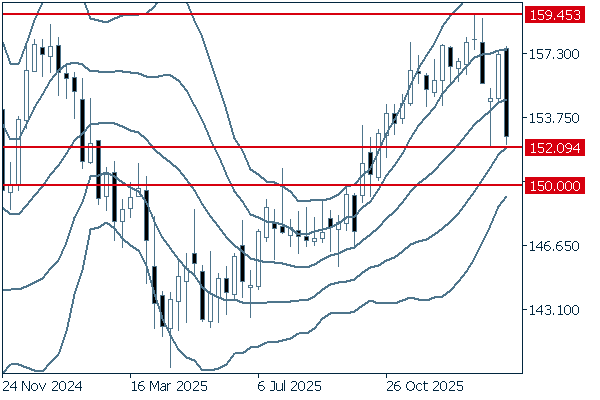
After the two-week rally, the pair offset it last week. If the pair fails to rebound at 152.09 yen and drops below that level instead, it will be safe to say that the downtrend will likely continue, as indicated by the daily chart.
Officials at the European Central Bank (ECB) are split over their views on a strong euro. This makes it difficult for traders to favor the euro. However, if the eurozone business confidence improves, the trend of euro selling is expected to recede.
Next is an analysis of the EURUSD daily chart.
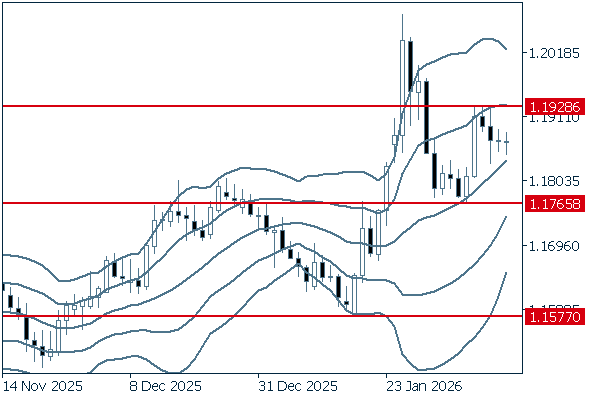
The pair is fluctuating above the middle line. Therefore, it is better to make sure to buy on dips. In the short term, it is important to focus on whether the pair can break above the 1.1928 level. If so, it will be safe to say that the uptrend will likely continue.
We continue with an analysis of the EURUSD weekly chart.
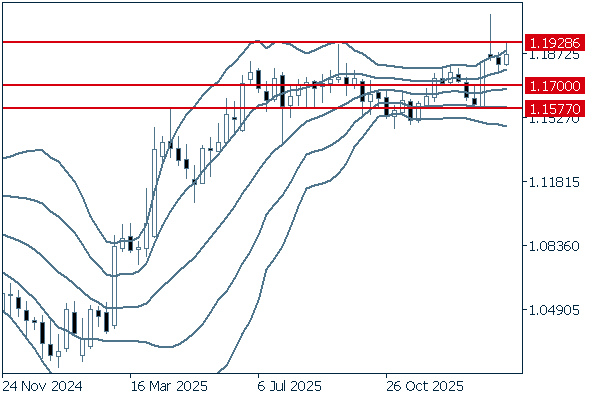
On the weekly chart, the pair broke above the upper limit of the fixed band but later moved back within it. Nevertheless, it can stay above +1σ. As long as the pair keeps fluctuating above the 1.17 level, it is safe to say that the uptrend will likely continue.
Recent economic indexes highlight the weakness of the U.K. economy, leading to lingering concerns over an economic downturn. If the January U.K. CPI, due out on February 18th, misses expectations, the sell-off of the pound will intensify as speculation of a rate cut mounts.
Next is an analysis of the GBPUSD daily chart.
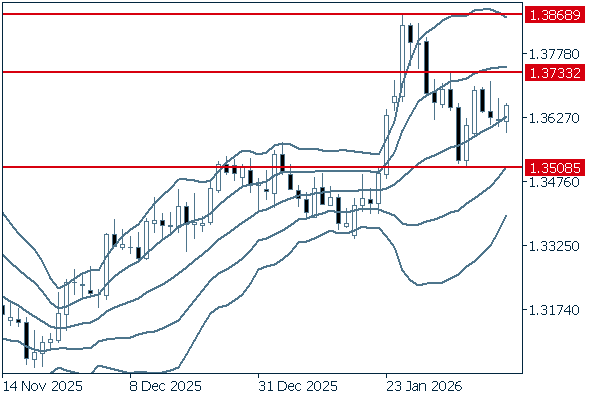
On the daily chart, the pair appears directionless. However, the middle line is trending upward. The current target of the pair is the 1.3733 level. As long as it stays above 1.3508, it is safe to say the uptrend will likely continue.
We continue with an analysis of the GBPUSD weekly chart.
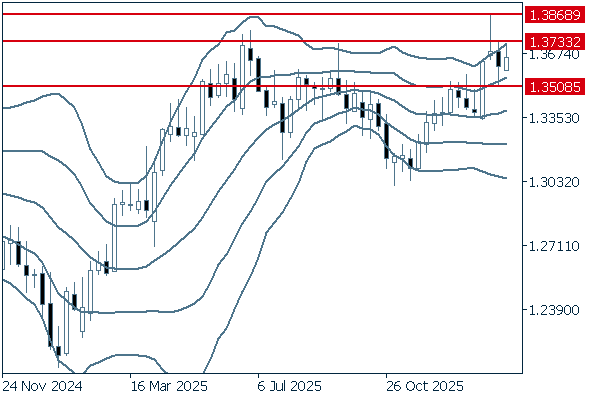
After reaching the 1.3868 level, the pair came back inside the band. Nevertheless, the pair rose last week and remains above +1σ, as indicated by the most recent positive candlestick. Although selling pressure increases at high levels, it is safe to say that the uptrend will likely continue as long as the pair stays above the 1.3508 level.
Don't miss trade opportunities with a 99.9% execution rate.
Was this article helpful?
 No
No
 Yes
Yes
0 out of 0 people found this article helpful.
Thank you for your feedback.


