

















2025.12.08
FXON Market Analysis (December 1 to December 7)

2025.12.08
This article was :
published
updated
Differences in monetary policy between the U.S. and Japan came into focus in the foreign exchange market for the week that ended on December 7th. Traders preferred the yen over the dollar, especially due to increasing speculation about a rate hike by the Bank of Japan (BOJ). Consequently, the USDJPY declined and briefly entered the mid-154 yen range during the week. Meanwhile, the euro and the pound strengthened against the dollar.
December 1 (Mon)
Traders preferred to buy the yen because Bank of Japan (BOJ) Governor Kazuo Ueda indicated the possibility of a rate hike. Consequently, the USDJPY fell to 154.89 yen.
As the dollar weakened against the yen, the EURUSD rose to the 1.165 range intraday, and the GBPUSD climbed to the 1.327 range.
December 2 (Tue)
Traders adjusted their positions to buy the dollar, pushing the USDJPY up to the 156.1 yen range. However, speculation about a BOJ rate hike halted the rally.
Meanwhile, the EURUSD hovered within the lower 1.16 range, and the GBPUSD was pushed down to the 1.317 range.
December 3 (Wed)
Weaker-than-forecast ADP Employment Report and ISM Non-Manufacturing PMI pushed the USDJPY just above the 155 yen level intraday.
In contrast, the euro and the pound strengthened against the dollar, lifting the EURUSD to the 1.167 range and the GBPUSD to the 1.335 range.
December 4 (Thu)
The dollar continued to weaken against the yen. The USDJPY failed to surpass the previous day's high and instead dropped as low as 155.66 yen.
The EURUSD halted its rally after reaching the 1.168 range. The GBPUSD hit the 1.338 range, but was then pushed down into the 1.331 range to close the daily trading session.
December 5 (Fri)
Since December 2nd, the yen had strengthened against the dollar. The USDJPY fell to a weekly low of 154.60 yen. However, it then rebounded and briefly reached 155.49 yen.
This trend triggered the selling of the euro and the pound. The EURUSD fell to the 1.162 range during the day, while the GBPUSD fluctuated around the 1.334 level to close the weekly trading session.
The following currency pair charts are analyzed using an overlay of the ±1σ and ±2σ standard deviation Bollinger Bands, with a 20-period moving average.
In the U.S., the Federal Reserve Board (FRB) is expected to make another rate cut this week. On the other hand, the BOJ will likely decide to raise rates again this month. The market will now shift its focus to whether the Japanese central bank will hike rates in 2026. If the interest rate difference between the U.S. and Japan is expected to shrink further, yen buying will dominate the USDJPY.
Next is an analysis of the USDJPY daily chart.
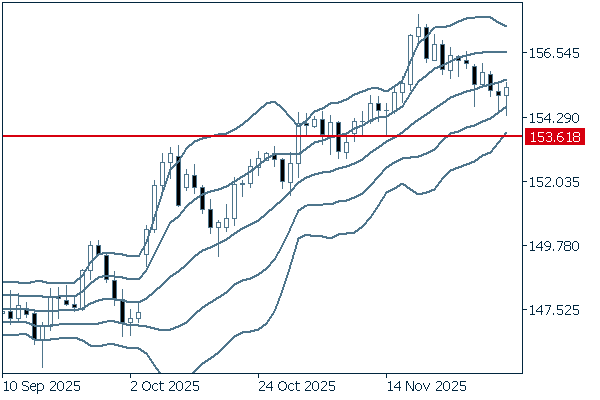
On the daily chart, the middle line is trending upward. However, the declining pair has been unable to surpass the previous day's high for several days. If the pair clearly drops below 153.61 yen, it may be safe to say that the pair has entered a downtrend.
We continue with an analysis of the USDJPY weekly chart.
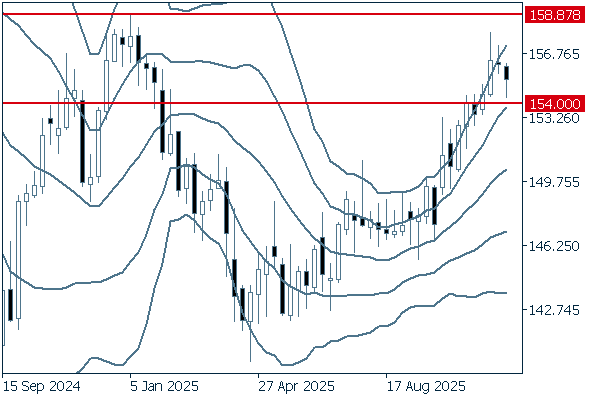
Although two consecutive negative candlesticks appear on the weekly chart, the latest candlestick has a long lower wick. Therefore, it is difficult to determine now whether the pair has entered a downtrend. However, if the pair falls below 154 yen, it may decline further.
If the FRB decides to make an additional rate cut at its FOMC meeting on December 9th and 10th, the euro will be favored over the dollar in the short term. On the other hand, the European Central Bank (ECB) is expected to maintain its current monetary policy at its Governing Council meeting on December 18th. Therefore, traders will be less inclined to sell the euro.
Next is an analysis of the EURUSD daily chart.

After halting its downtrend, the pair climbed back to the upper limit of the band, where it was pushed down last week. To determine the medium-term trend, it is important to focus on whether the pair can break above the 1.1728 level.
We continue with an analysis of the EURUSD weekly chart.
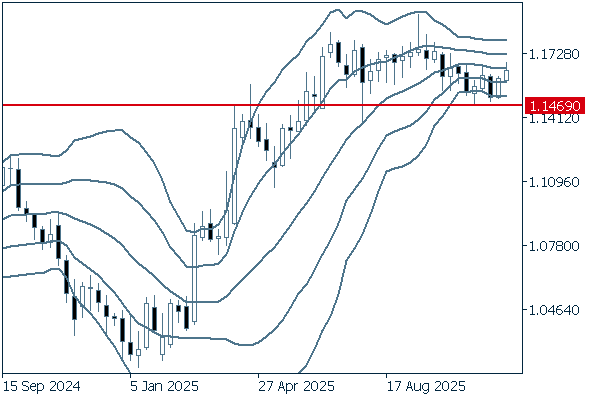
The pair has been moving within a shrinking bandwidth. However, the pair temporarily broke above the middle line last week. If the pair concludes the weekly trading session above the middle line, it will be safe to say that the pair is in an uptrend, unless it falls below the 1.1469 level.
Spreading uncertainties about the outlook of the U.K. economy, as well as disagreements among Bank of England (BOE) policymakers, are preventing traders from actively buying the pound. Meanwhile, the FRB will likely lower interest rates this month. Consequently, the dollar will be sold and, in turn, the GBPUSD will advance.
Next is an analysis of the GBPUSD daily chart.
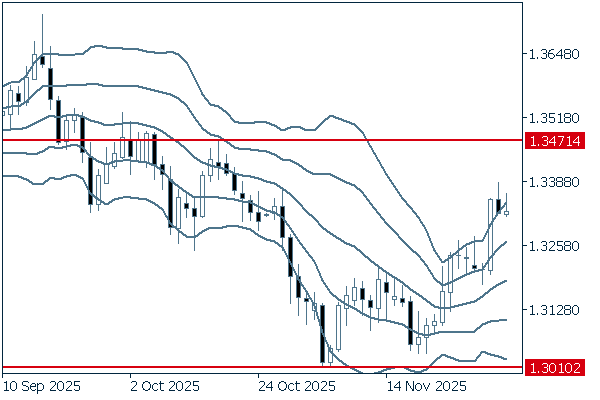
After a brief dip, the pair rebounded to the upper limit of the band. Two long upper wicks indicate that the rally has been capped. However, if the rally resumes, the pair could advance as high as the 1.3471 level.
We continue with an analysis of the GBPUSD weekly chart.
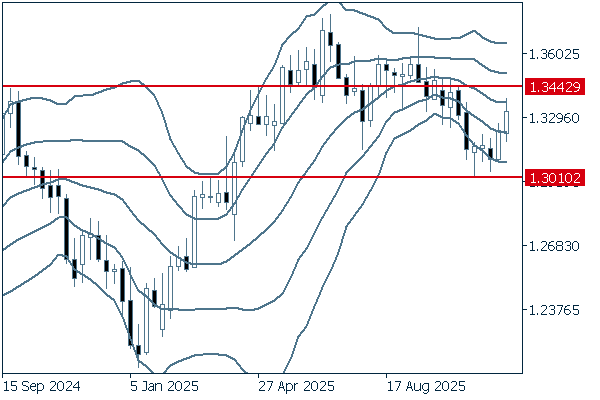
As with the daily chart, the weekly chart shows that the pair has halted its downtrend and is about to enter a renewed trend from a medium-term standpoint. If the pair crosses above the middle line, it will be able to target the 1.3442 level in the short term.
Don't miss trade opportunities with a 99.9% execution rate.
Was this article helpful?
 No
No
 Yes
Yes
0 out of 0 people found this article helpful.
Thank you for your feedback.


