

















2025.12.01
FXON Market Analysis (November 24 to November 30)

2025.12.01
This article was :
published
updated
In the foreign exchange market for the week that ended on November 30th, trading volume decreased ahead of the Thanksgiving holidays. Amid the corrective mood, there was mixed speculation about December rate cuts in the U.S. and Japanese fiscal and monetary policies. Thus, the USDJPY fell to the mid-155 yen range.
Meanwhile, both the EURUSD and GBPUSD moved solidly throughout the week.
November 24 (Mon)
The USDJPY started the weekly trading session by rising to the 157.1 yen range. However, the pair then struggled to advance further after comments by a Federal Reserve Board (FRB) executive reignited speculation about a U.S. rate cut in December.
Meanwhile, the EURUSD rose to the 1.154 range, and the GBPUSD hovered within the 1.31 range.
November 25 (Tue)
The USDJPY struggled to advance amid fears of possible intervention by the Japanese government and the Bank of Japan (BOJ). Additionally, the market reinforced speculation that the FRB would cut rates in December. Consequently, the yen was favored, and the USDJPY fell to the 155.8 yen range.
As the dollar weakened, the EURUSD rose to the 1.158 range, and the GBPUSD climbed to the 1.32 range.
November 26 (Wed)
Some media outlets reported that the BOJ had resumed a hawkish stance and might raise interest rates in December. This news accelerated buying of the yen, and the USDJPY fell to 155.65 yen during Tokyo trading hours. However, the pair then rebounded to 156.73 yen.
Meanwhile, the EURUSD rose to the 1.16 range, and the GBPUSD reached the 1.324 range.
November 27 (Thu)
Since the U.S. market was closed for Thanksgiving, trading volume was light. In particular, the USDJPY hovered within the lower 156 yen range at New York time.
After reaching a weekly high of 1.1613, the EURUSD fell but stayed around the 1.16 level. The GBPUSD followed suit, falling after reaching a weekly high of 1.3268, though it remained above 1.323.
November 28 (Fri)
On the day between Thanksgiving and the weekend, the market was quiet. The USDJPY fluctuated within the lower 156 yen range. The EURUSD pair fell to the 1.156 range but recovered to the 1.16 range. After slight price movements, the GBPUSD closed the weekly trading session in the 1.32 range.
The following currency pair charts are analyzed using an overlay of the ±1σ and ±2σ standard deviation Bollinger Bands, with a 20-period moving average.
The market increasingly expects the Federal Open Market Committee (FOMC) to lower the interest rate by 0.25% at its December meeting. Meanwhile, the BOJ is expected to raise interest rates in December. The market will be affected by headlines about the shrinking interest rate differential.
Next is an analysis of the USDJPY daily chart.
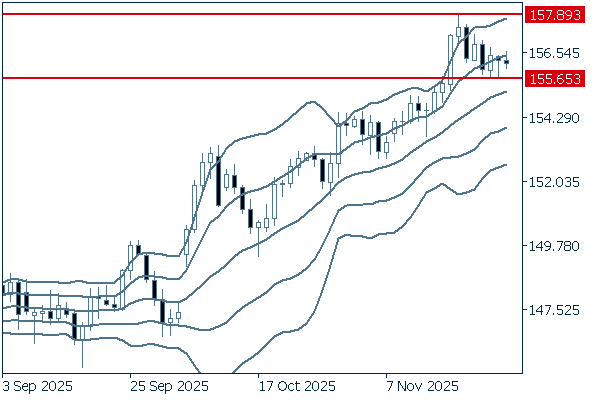
Since reaching 157.89 yen two weeks ago, the pair entered a correction phase and crossed below +1σ last week. It seems like a good time to take advantage of this decline to buy the dollar. However, if the pair falls below last week's low of 155.65 yen, it could drop as low as 155.0 yen.
We continue with an analysis of the USDJPY weekly chart.
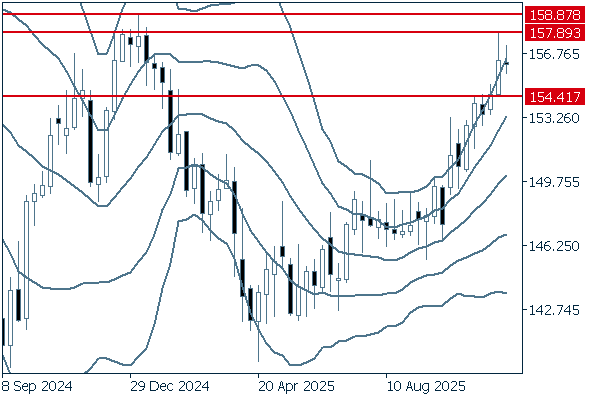
On the weekly chart, the sharply rising middle line suggests that the pair's strong uptrend is continuing. However, the pair is also facing gradually increasing selling pressure. If the pair closes the weekly trading session beneath 154.41 yen, it could signal a reversal to a downtrend.
The momentum of buying euros, which had been supported by anticipation of a U.S. rate cut in December, is about to wane. The market will then turn its attention to the employment situation in Europe. The November Harmonized Index of Consumer Prices (HICP) figures will be released on December 2nd. If these figures miss market forecasts, traders will take a risk-off stance and sell the euro to buy the dollar.
Next is an analysis of the EURUSD daily chart.
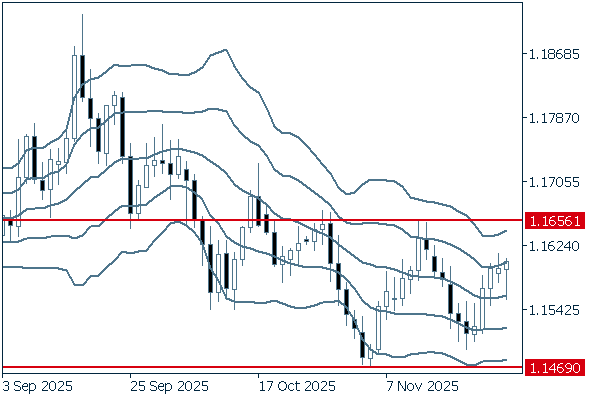
As five positive candlesticks on the daily chart indicate, the pair advanced for five consecutive days last week. This rally halted the decline of the middle line, which is now about to flatten. If the pair breaks above the 1.1656 level, a reversal to an uptrend may occur. On the other hand, if the pair falls below 1.4690, the downtrend will likely resume.
We continue with an analysis of the EURUSD weekly chart.
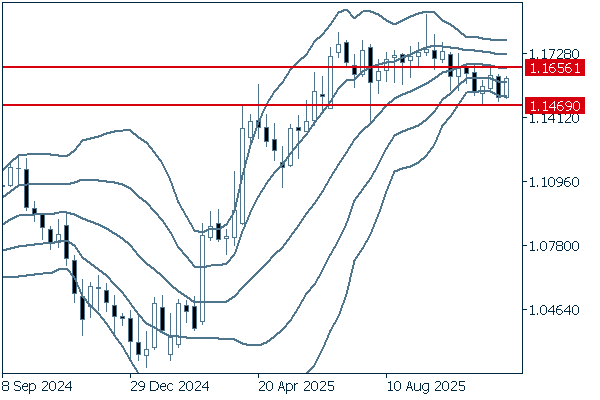
On the weekly chart, since the conclusion of the uptrend, the bandwidth has been narrowing, and the pair has been fluctuating within a narrow range. It would be better to watch whether the pair breaks above the 1.1656 level or falls below the 1.1469 level. In the former case, the pair may enter an uptrend. Otherwise, a downtrend may occur.
The market positively accepted the Starmer Cabinet's budget plan. The pound selling, which had been triggered by concerns over the U.K.'s financial problems, seems to have concluded for now. Since no major economic data will be released this week, the dollar's behavior will dominate the GBPUSD.
Next is an analysis of the GBPUSD daily chart.
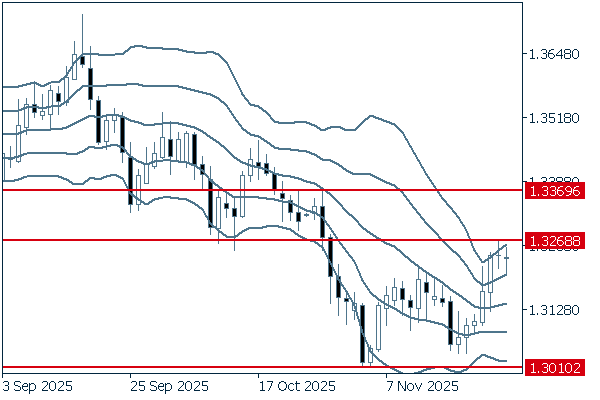
Last week, the pair advanced to reach 1.3268, which turned out to be the weekly high, before being pushed down. However, consecutive positive candlesticks on the daily chart indicate that the pair has bottomed out. It is now important to watch whether the pair can break above the 1.3369 level.
We continue with an analysis of the GBPUSD weekly chart.
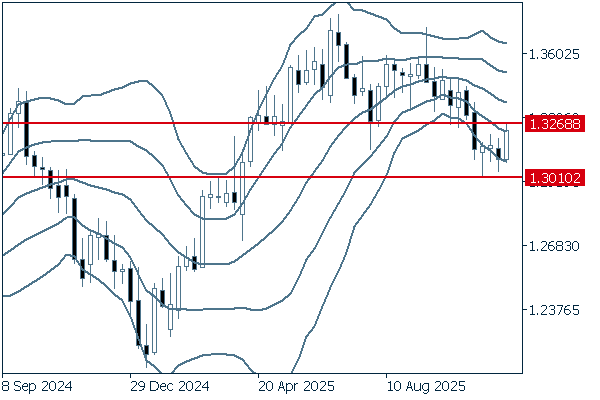
The pair stopped its decline before reaching 1.30 and then rose to touch -1σ. It is now important to watch whether the pair can hit a new high.
Don't miss trade opportunities with a 99.9% execution rate.
Was this article helpful?
 No
No
 Yes
Yes
0 out of 0 people found this article helpful.
Thank you for your feedback.


